SB 568
Effective FY 2027, funding follows the intensity of services each student receives — not where they sit, not their disability label. This page explains what changed, what it costs to get wrong, and how Accord is built for it.
Before SB 568
Placement-based funding
Funding followed where the student sat — mainstream, resource room, self-contained. One placement code per student, submitted to PEIMS. Your IEP system tracked that code.
After SB 568
Intensity-based funding
Funding follows what the student actually receives. Eight intensity tiers (§48.102) plus four or more service group allotments (§48.1021), tracked across six-week reporting periods. A single student can generate multiple allotments.
This isn't a new PEIMS field. It's a different kind of data — service delivery documented at point of service, mapped to tiers, reported in periods that don't align with existing submission cycles. The commissioner is still finalizing tier and service group definitions.
$86K+
per student per year if a Tier 7 student is coded as Tier 6
$250K
annual loss for 100 students classified one tier low
$16M
returned by 573 Texas districts in SHARS recoupments (2024)
Roughly $250 million in new statewide funding is accessible only to districts that can prove intensity. Documentation timing is a primary audit trigger. The districts that can prove what each student receives will capture it. The districts that can't will subsidize those that can.
Legacy IEP platforms sync placement codes to your SIS via nightly batch. Published reports put the error rate on program and service dates around ninety percent. Unlocked IEP meetings break reporting triggers. Dyslexia data often requires separate manual entry. None of the major Texas platforms have announced SB 568 support.
These platforms were built to answer "where does the kid sit?" SB 568 asks "what does the kid get?" That's not a settings change. It's a different architecture.
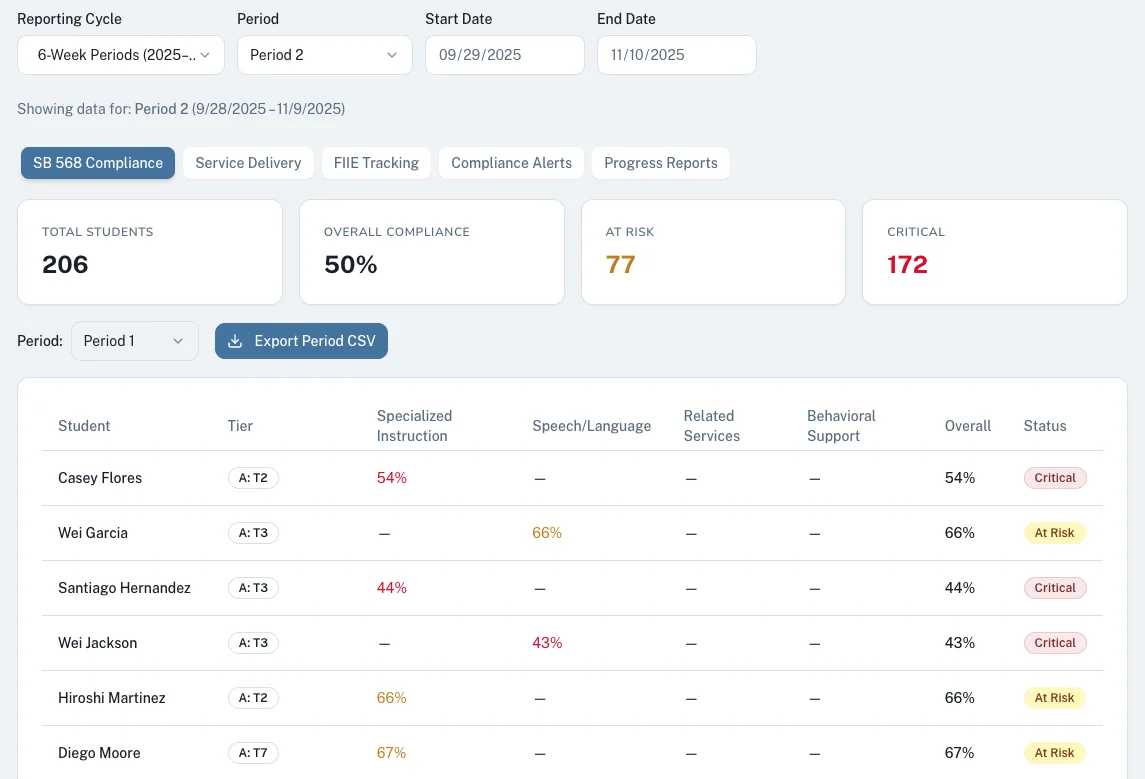
Tier data, service group compliance, and period-based reporting as first-class product features — not a PDF export you run once a year.
Point-of-service logging with immutable timestamps.
Every service session is logged when it happens, by the person who delivered it, with a creation timestamp that can't be altered. Bulk-backdating is architecturally impossible. Your six-week period data reflects reality, not month-end reconstruction.
Intensity tiers and service groups as native data.
Not retrofitted codes. Every student's services calculate their tier automatically. The system shows the mapping logic — why this student is Tier 3 vs. Tier 4, which service group allotments apply. When definitions change, assignments recalculate. No manual remapping.
Budget forecasting across both allotment streams.
If 200 students move from Tier 2 to Tier 3 due to service changes, what happens to your budget? Accord models it — for tiers and service groups — so you see the funding impact before you make the change.
PEIMS-compatible data exports.
Clean, contemporaneous, point-of-service data mapped to TSDS formats. When TEA publishes the 2026–27 data standards, your data is already structured to export. No re-keying. No manual verification. No hoping your October snapshot holds up.
Flexible rules engine for definitions that haven't been finalized yet.
Both tier and service group definitions are still being written by the commissioner. You need architecture that adapts when they arrive — without re-entering data or reconfiguring the system. Accord is designed for exactly that.
Now
RFP season Q2–Q4 2026. Districts are evaluating platforms. TEA commissioner still finalizing tier and service group definitions. No incumbent has announced SB 568 support.
Fall 2026
New TSDS data standards expected. Districts need infrastructure in place to start tracking intensity data from day one of the school year.
FY 2027
SB 568 effective. Funding flows through the new model. Districts that can prove intensity capture roughly $250M in new funding. Districts that can't, don't.
We're partnering with mid-size Texas districts for the 2026–27 school year. If your district is feeling SB 568 pressure and wants infrastructure that's ready before the rules are final, we should talk.