For Texas SPED directors.

Texas SPED software for the new funding model.

Accord is built around TEA's new intensity-of-services funding model — the rubric every Texas district has to populate for every special-education student before the 2026–27 school year. It's also where your team logs services and tracks goal progress all year, for the same students.
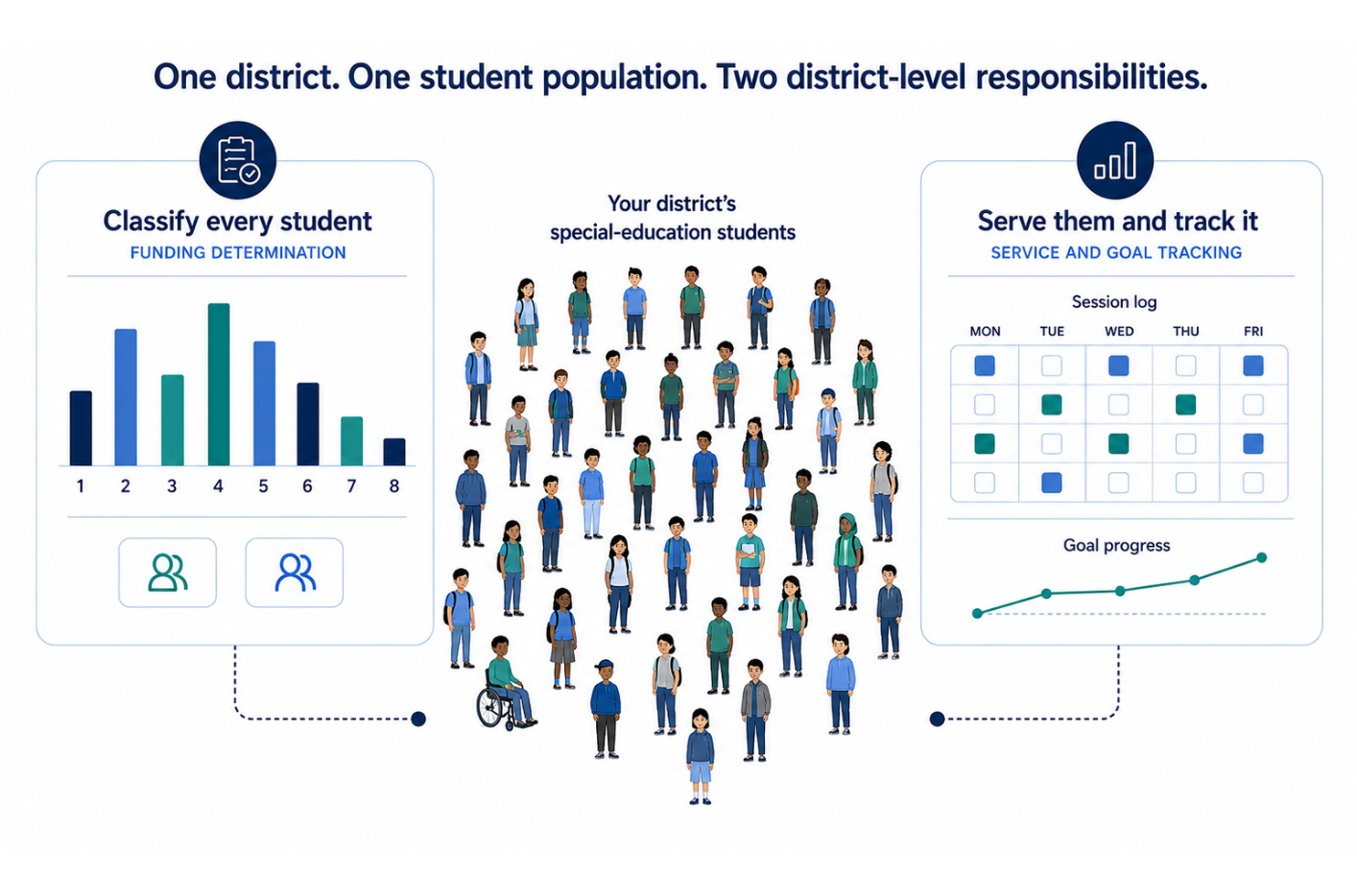
Two-phase cycle diagram — funding determination in the summer and service-and-goal tracking across the school year, both anchored to the same imported IEPs.

The rubric just landed.

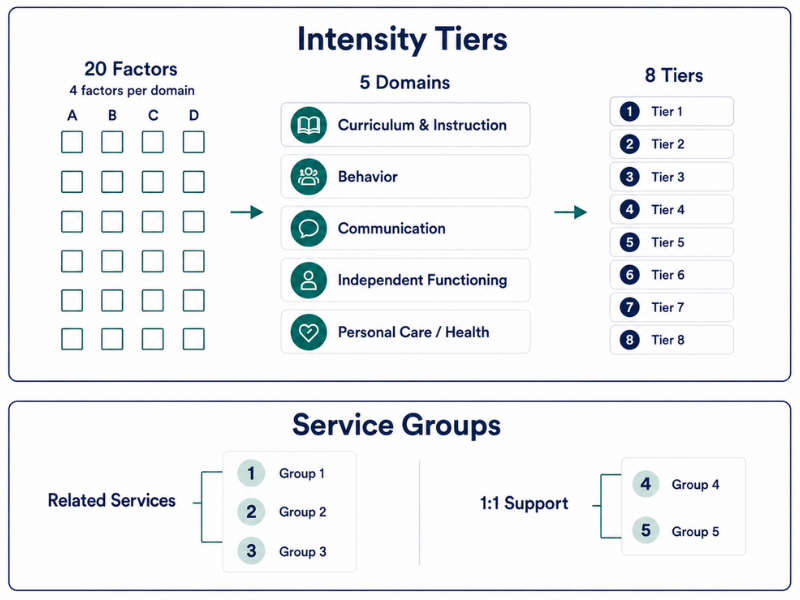
Twenty factors, five domains, eight intensity tiers, and up to two service groups.

Districts have known for two years that Texas was rewriting special-education funding. On April 16, 2026, TEA published the rubric: twenty factors scored across five domains that combine into one of eight intensity tiers. Every student with an IEP also qualifies for up to two service groups on top of the tier. Districts have to assign a tier and the service-group qualifications for every special-education student before the 2026–27 school year, in anticipation of the October 8 PEIMS submission. TEA is asking for early voluntary submissions by August 14.

Framework hierarchy diagram — twenty factors grouped into five domains, combining into eight intensity tiers, with service groups branching as a parallel track.
Many-to-one contrast diagram — a stack of messy TEA tool exports on the left, one clean consolidated Accord dataset on the right.

Alongside the rubric, TEA published a funding-determination tool: a single browser session, no login, no shared workspace, no district view. TEA's FAQ tells districts to export from the tool to Excel and merge the files into a master spreadsheet by hand, by campus or by case manager.

Accord is the same rating work in a place where the district actually lives. Every special-education student has their own record, with TEA's rubric surfaced alongside the IEP that's being rated. Case managers work their caseloads in parallel. The director watches the work come in and the distribution take shape across all eight tiers and the service groups. When the work is approved, the consolidated dataset is one click away — for August 14, for October 8, and for the determinations as they revise through the year.

Funding determination.

A tier and service-group view of your district, in real time.

Funding-determination wizard mid-rating — relevant IEP content on one side, rubric language for the current factor on the other.

Accord pre-populates a draft determination for every student with an IEP at import. A wizard walks the case manager through the twenty factors, with the relevant IEP content and the rubric for that factor in the same window — no toggling between pop-ups, no copying between tabs. The result is a tier, the service-group qualifications, and a per-student rationale that uses TEA's own language for each rating.

A district view, not just per-student.

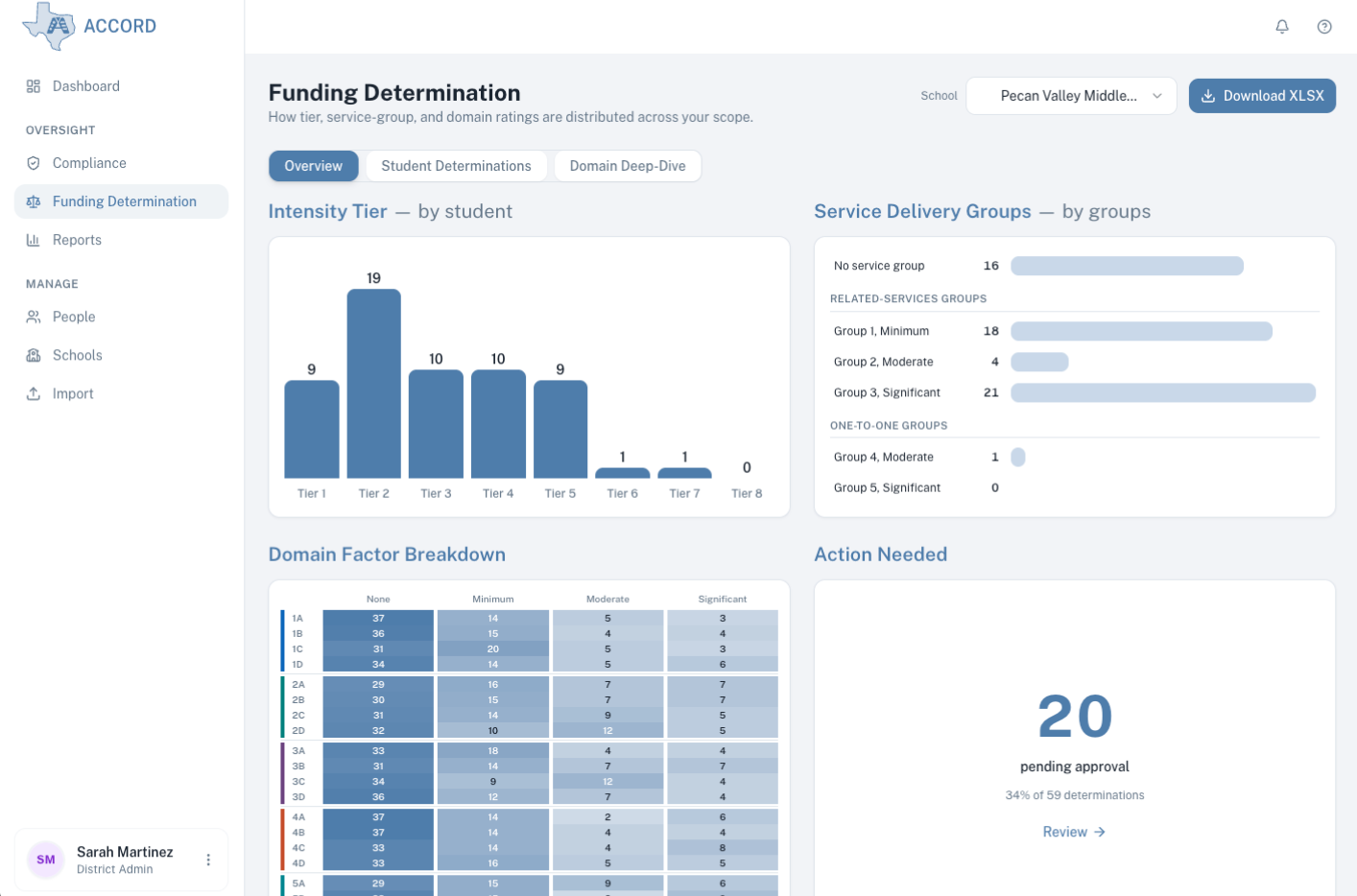
Tier distribution across all eight tiers, the related-services minutes breakdown, and the dedicated 1:1 staffing breakdown — visible at a glance, filterable by campus, with what's still pending review surfaced alongside.

District funding dashboard — tier histogram across Tiers 1–8, service-group breakdown, per-campus filter, and pending-review queue.

The framework's own words on every rationale.

Drill into any student and the per-domain breakdown is on the page using TEA's exact language for each rating level — not paraphrased.

Per-student rationale view — five domains with assigned rating levels and TEA's exact language for each level quoted verbatim underneath.
Case-manager-to-district roll-up — case manager's approval queue on the left, the district's consolidated-dataset view on the right.

Case managers do the rating, the district sees the result.

Each draft routes to the case manager who owns the IEP for review. Approvals roll up into the consolidated dataset ready for submission.

Service and goal tracking.

What every IEP prescribed, what your team delivered.

The same students whose tiers and service groups you just classified are the ones your team is serving every day of the school year. Accord is the workspace where providers log services as they're delivered and capture goal-progress data toward the goals each student's IEP names. The director sees the gap between what's prescribed and what's been delivered — by student, by service type, by campus — in real time. When a parent, a hearing officer, or TEA asks what was delivered for a student, the answer comes from a record that exists.

Captured the day the work happened.

Providers log sessions in the workflow they're already in, and goal progress is recorded as it accumulates — for each goal a student is working on, by the provider doing the work.

Provider logging view — a session being marked delivered with the student's goals listed and goal-progress data being captured alongside.

The gap visible early, not at year-end.

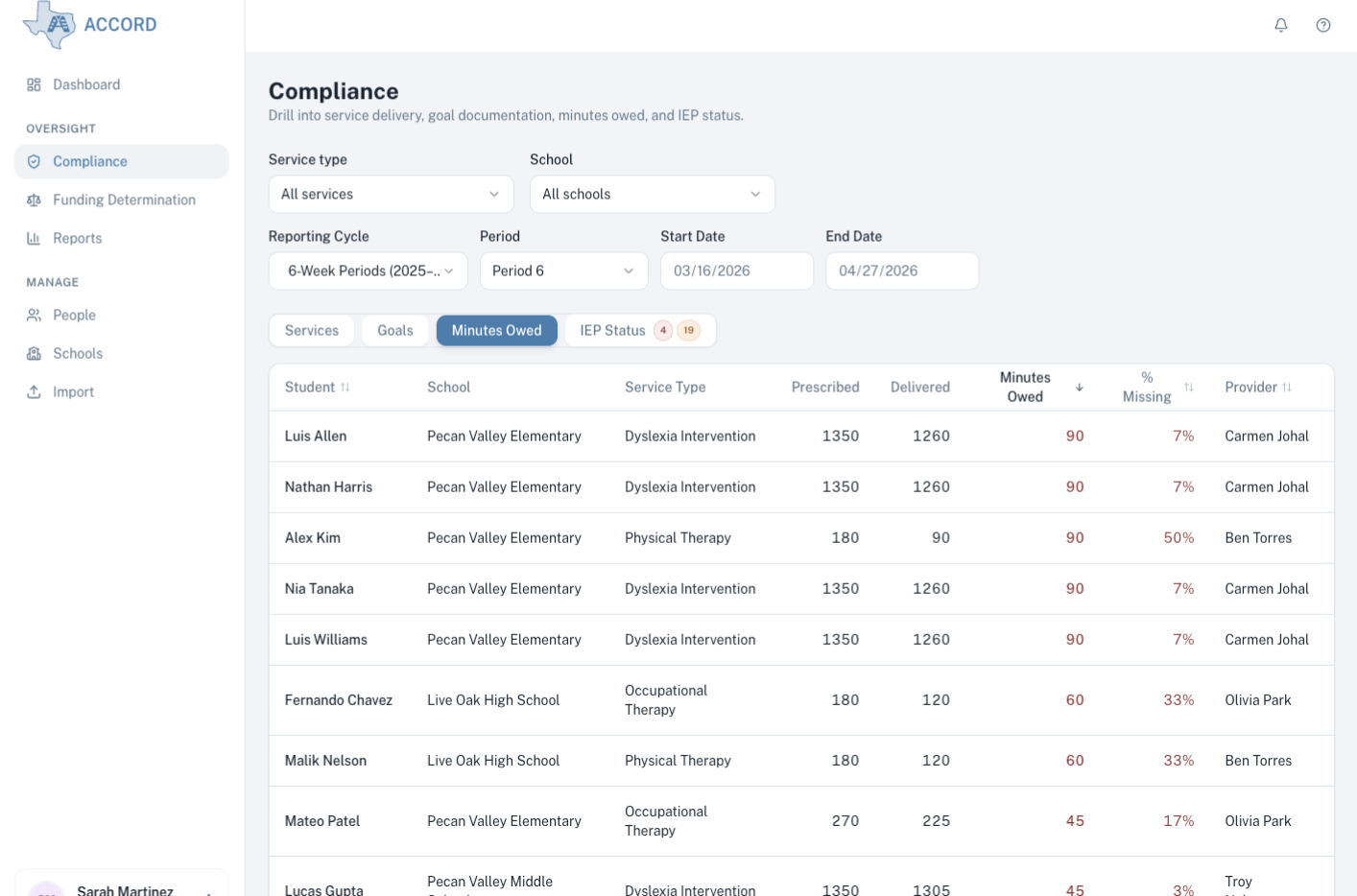
The dashboard shows where service delivery is drifting from what each IEP prescribed — early enough to address with the campus, not late enough to need a corrective action plan.

Director gap dashboard — prescribed-vs-delivered across the district, filterable by student, service type, and campus.

For Texas districts working on this now.

Built for the districts where one Excel file isn't enough.

The rubric is published. The first day of school is in August. The October 8 PEIMS submission carries the new tier-and-service-group data for every special-education student. The TEA tool gets a tiny district through summer. For districts with multiple case managers rating hundreds of students in parallel, the work needs to consolidate as it happens.

Districts adopt Accord this summer for the funding-determination work. They keep using it because the service-and-goal capability is the visibility into their own department that a SPED director has never had — the prescribed-vs-delivered picture by student and by campus, available the day it changes, not in summary form weeks later. The progress reports providers write are easier to produce when the data is already flowing in continuously.

See how Accord handles the new framework on a sample Texas district.

You'll see the district view across the tiers and service groups, the wizard your case managers will use, and the prescribed-and-delivered picture by campus.