For the State of Texas.

A funding model calibrated on this year's data needs a state-level solution this year.

Every student in Texas special education is being classified into the new intensity-of-services model right now — by hundreds of districts working alone, with no way to know whether two raters reading the same IEP land on the same tier. Those classifications are what the Legislative Budget Board will estimate from and what settle-up will be built on. The one part of that process the state controls is the solution it provides — and in a calibration year, that solution has to keep ratings consistent across districts and show the state its distributions before PEIMS.

The stakes.

The model's first year is its calibration year.

Tier weights and service-group amounts get set at settle-up in September 2027 — from the distributions districts report in 2026–27. If year-one ratings drift district by district, the weights get set on noise.

TEA's guidance requires that every reviewer of the same IEP arrive at the same determination. No mechanism — in PEIMS, or anywhere the data currently flows — verifies that it's being met. Consistency will exist only where the workflow enforces it.

The August 14 voluntary submission gives the state one early look, at 15% of students. The next comes with the October 8 PEIMS snapshot; the last on December 3. Everything the state will know about the model's first year arrives in those three windows.

Vendor readiness vs. the state-level solution.

Vendor readiness solves the districts' problem. It never solves the state's.
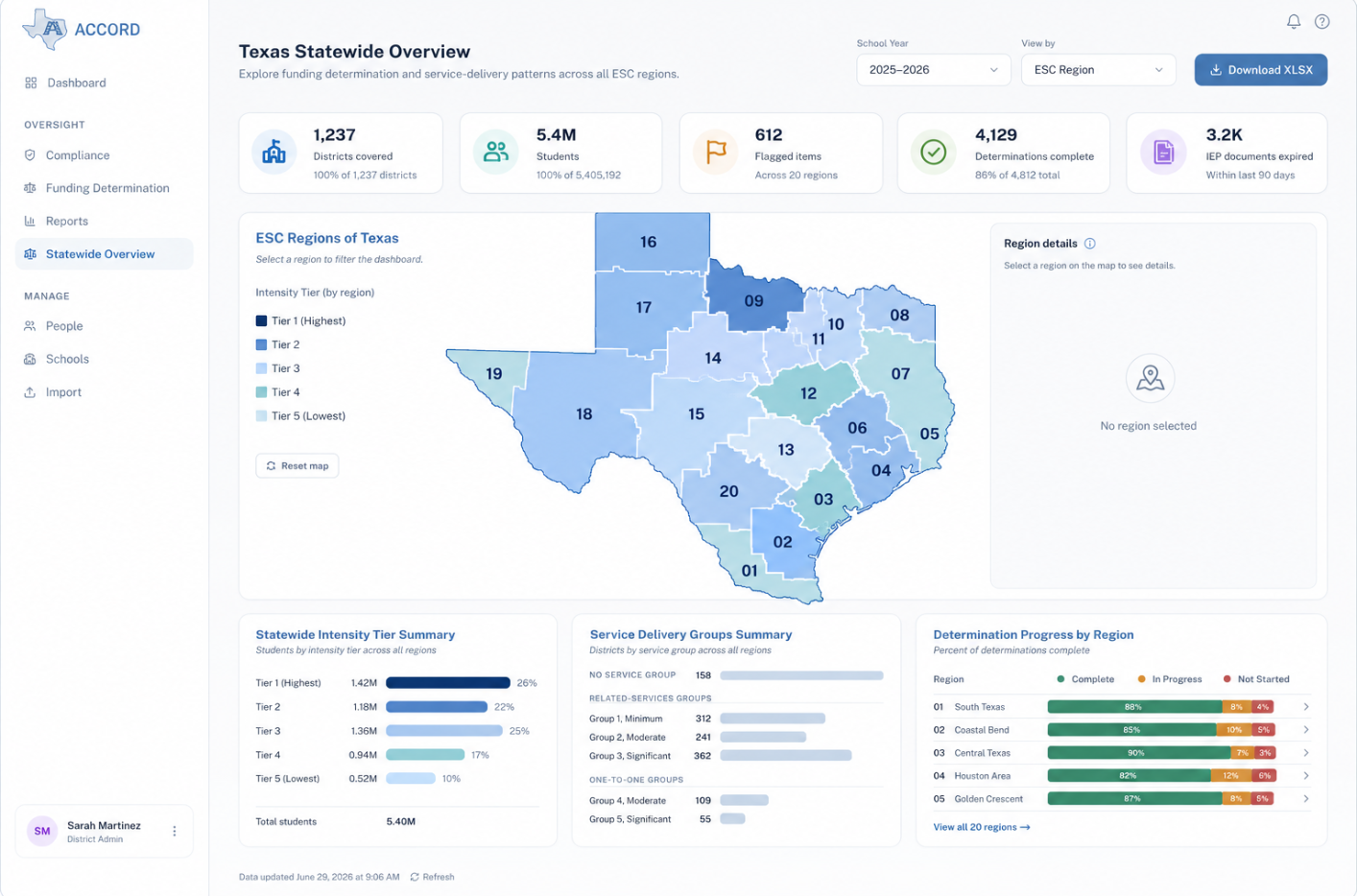
Accord Texas Statewide Overview — funding-determination and service-delivery patterns across ESC regions, with a statewide intensity-tier summary, service-group summary, and determination progress by region.

TEA's vendor-readiness goal is aimed at the IEP-authoring vendors — the systems districts already use — embedding funding-determination support in their products by 2027–28. That's a fair goal for the district track: providers deserve determination support built into the tools they work in every day.

But even fully realized, that track gives the state nothing new. Determinations scattered across a dozen vendors' systems come with no way to check consistency across districts and no signal until PEIMS — exactly the visibility the state has today. Statewide consistency and continuous distribution visibility only come from one place: the solution the state itself provides.

Nothing fills that role today. The state provides a way to enter each student's rating; what a calibration year needs is a solution that also holds ratings consistent across districts and rolls the results up, so the state can watch tier and service-group distributions as they form. That means working at both ends — supporting the provider through the determination itself, and consolidating the results upward. Accord does both: rubric-anchored ratings from the student's IEP, review with the rubric and the IEP in the same window, and consolidation into one live view across all eight tiers and both service groups — ready in the one year that sets the weights.

What Accord gives Texas.

Consistent ratings in every district, and the distributions visible as they form.

Every rating in Accord is made with the same rubric, in the same workflow, with the same guidance at the moment of judgment. Every district working in Accord rolls up into one consistent dataset: tier and service-group distributions the state can watch as they form, with signal in hand before the estimates and the weight-setting are due.

The calibration year is now.

District vendors will catch up on their own track. The state-level solution — the one that determines whether year-one data is consistent enough to set weights on — is a choice Texas can make this year. We're working with Education Service Centers and districts across the state to make the case. If you work at TEA or the LBB, we'd like to show you what the data can look like.