For Texas SPED directors.

Domains, tiers, and groups — Texas's new funding model.

The TEA Commissioner recently published the New Intensity of Services Funding Model rubric. While prior funding models used an instructional-arrangement formula, this new model determines an intensity tier for each student through twenty factors across five domains, and up to two service groups based on related services and 1:1 support.
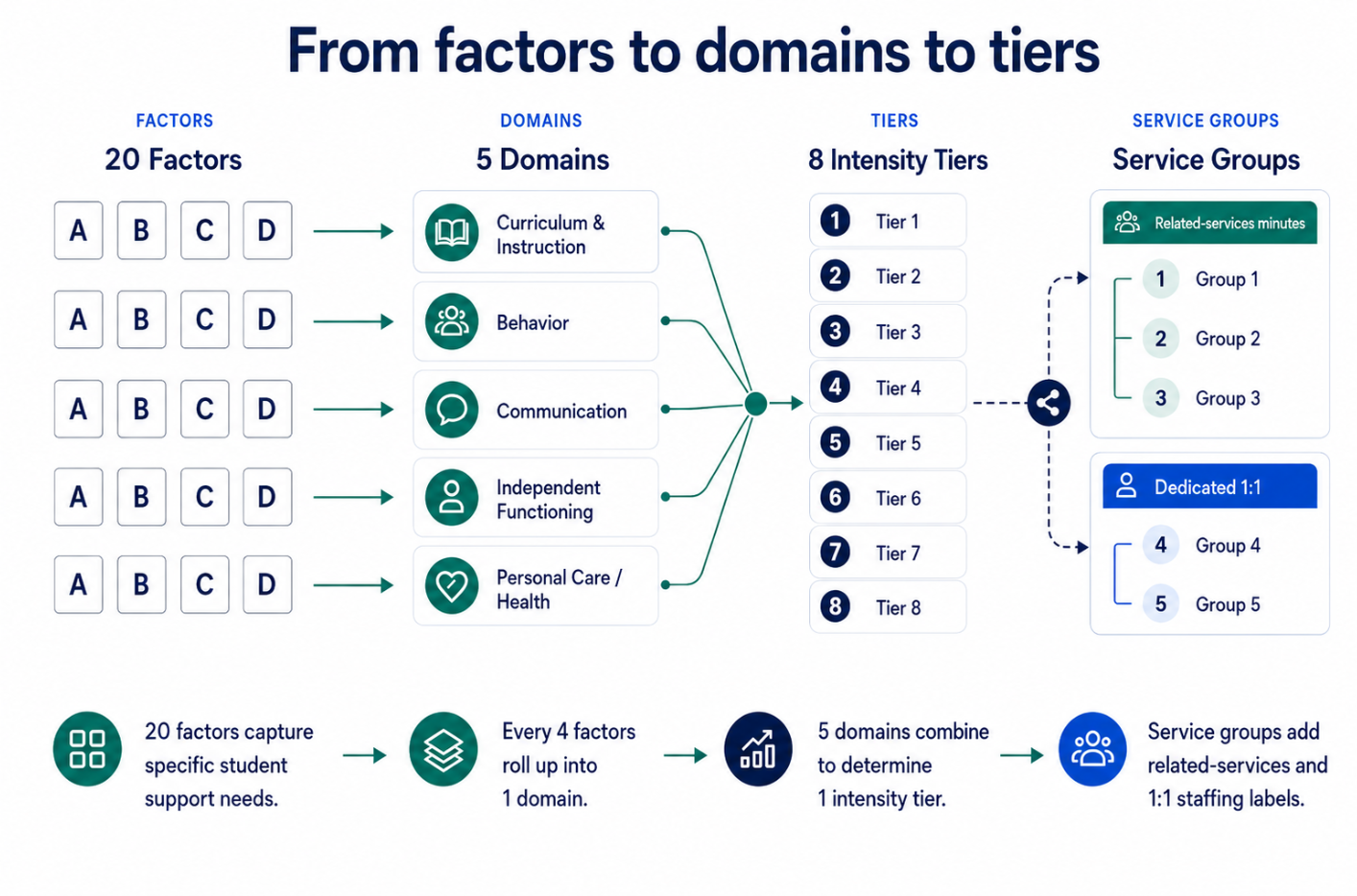
Framework hierarchy diagram — twenty factors grouped into five domains, combining into eight intensity tiers, with service groups branching as a parallel track.

The shift.

From the placement code to what the IEP specifies.

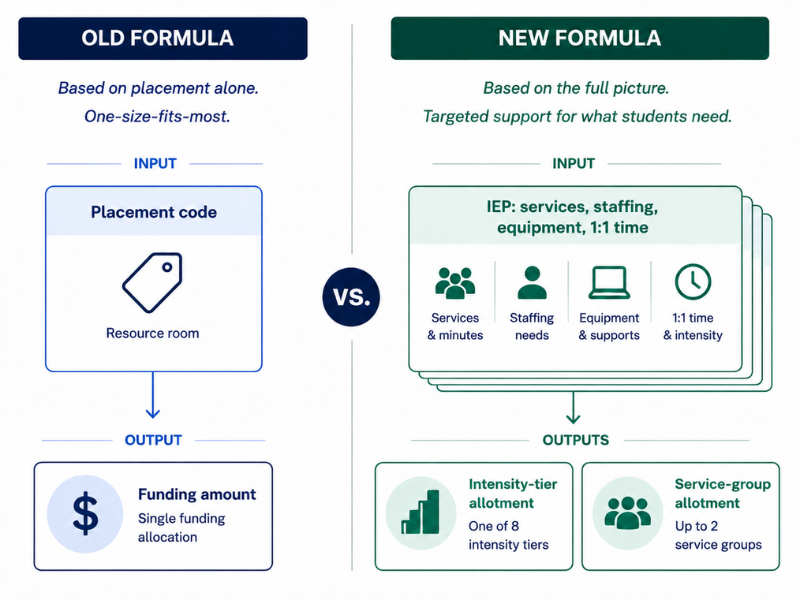
HB 2 (Article 4) carries the same special-education funding overhaul as SB 568. Both replace the prior instructional-arrangement formula with two stacked allotments — an intensity-tier allotment under TEC §48.102 and a service-group allotment under §48.1021. The old formula keyed funding to a placement code (resource room, self-contained, homebound). The new formula is anchored to the IEP itself — the services, staffing, equipment, and 1:1 time it specifies. The Commissioner's framework, published April 2026, is the rubric districts apply.

Old vs. new formula contrast — one placement code in, one number out on the left; rich IEP content in, an intensity tier and a service-group allotment out on the right.

What the framework rates.

The framework rates each student's level of support across five domains: Curriculum & Instruction, Behavior, Communication, Independent Functioning, and Personal Care/Health. Each domain has four factors — what type, frequency, and nature of services are required; whether specialized provider credentials are required; whether a specific provider-to-student ratio is required; whether specific equipment or technology is required. Each factor is rated on a four-level scale: None, Minimum, Moderate, Significant. The IEP is the anchor for every rating — the rater reads the IEP and rates each factor based on what the IEP documents.

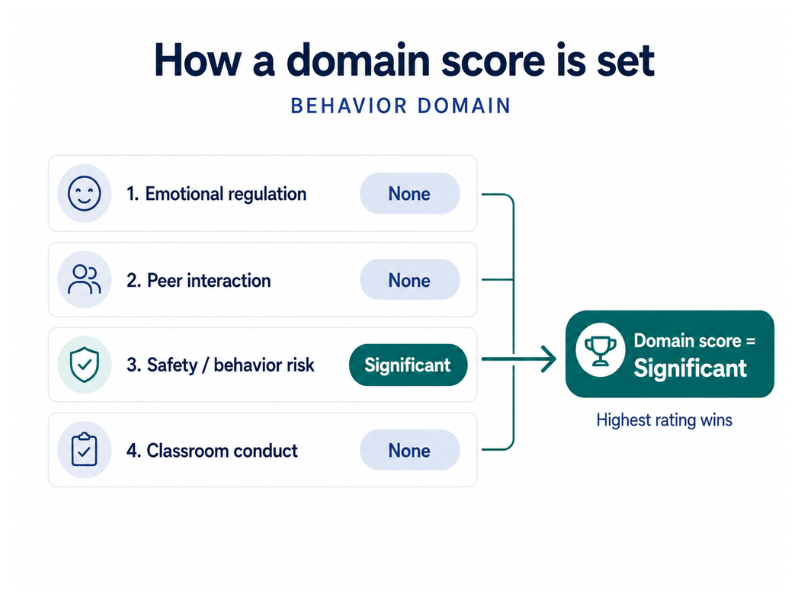
One domain's four factors as four rows — one at Significant, three at None — with the domain score resolving to Significant.

Within a domain, the domain score is the highest rating across that domain's four factors. A domain with one factor at Significant and three at None still scores Significant. This is the framework's deliberate choice: a domain only needs one significant support to make the domain itself significant.

How a student's tier is determined.

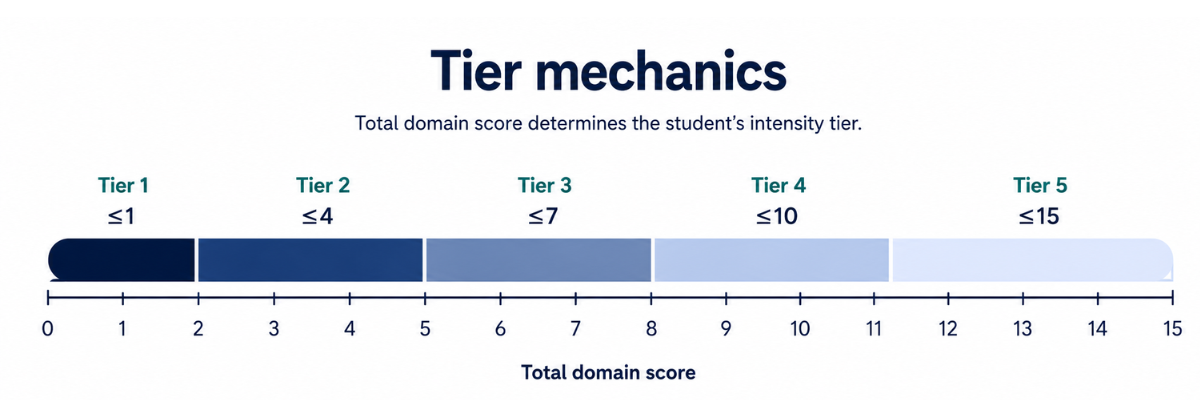
The five domain scores combine into one of eight intensity tiers. Most students land on Tiers 2 through 5 by the standard ladder, summing the domain scores — total ≤ 1 = Tier 1, ≤ 4 = Tier 2, ≤ 7 = Tier 3, ≤ 10 = Tier 4, ≤ 15 = Tier 5. Tier 1 and Tiers 6–8 are reached differently.

Horizontal tier ladder — a number line from 0 to 15 with five segments labeled Tier 1 through Tier 5.
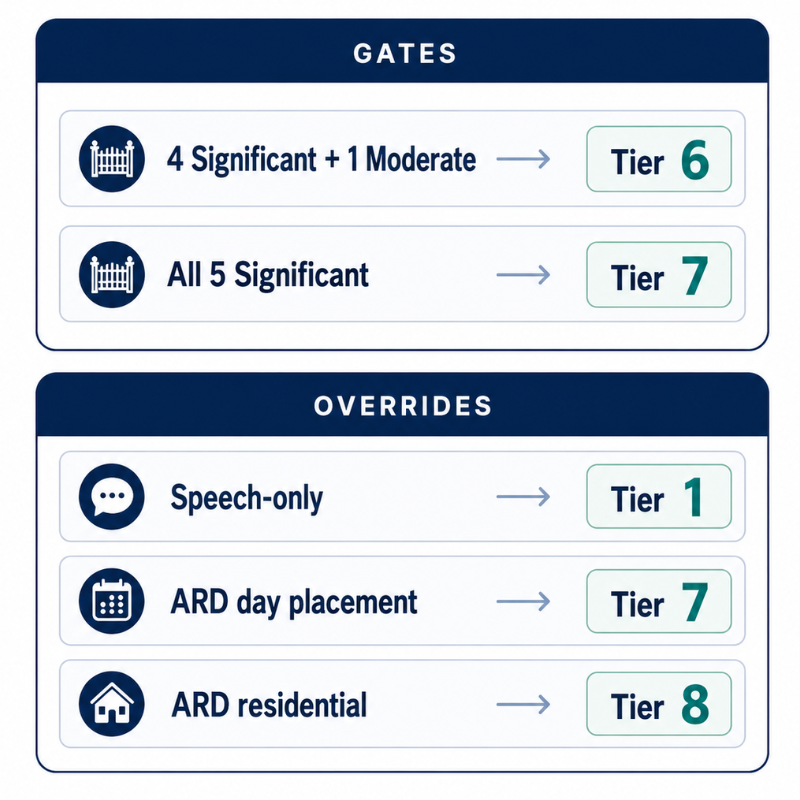
Compact reference card — Gates (Tier 6 and Tier 7 trigger conditions) and Overrides (Speech-only to Tier 1, ARD day to Tier 7, ARD residential to Tier 8).

Tiers 6 and 7 require specific configurations of the domain scores, not just a high sum. Tier 7 requires all five domains to score Significant. Tier 6 requires four domains at Significant and one at Moderate. These are gates: a student with a high total but the wrong pattern of domain scores does not reach Tier 6 or 7 by the ladder alone.

Three overrides short-circuit the tier calculation entirely:

  • Speech-only. A student whose only instructional service is speech therapy is forced to Tier 1, regardless of factor ratings.
  • ARD-committee day placement. A student placed by ARD committee in a public or private day placement program is forced to Tier 7.
  • ARD-committee residential placement. A student placed by ARD committee in a residential placement program is forced to Tier 8.

Even when an override applies, the framework asks raters to still rate each factor and score each domain — the rating data feeds master scheduling, staffing, and reintegration planning, even where it doesn't drive the tier.

Up to two service groups, in addition to the tier.

A student can also qualify for up to two service groups in addition to the tier. The framework defines five service groups in total — three based on related-services minutes, two based on dedicated 1:1 staffing — and a student can qualify for at most one from each set.

Groups 1, 2, and 3 are mutually exclusive on related-services minutes per six-week period:

  • Group 1. 180–270 minutes per six-week period — or the student requires special transportation as a related service — or the student requires parent counseling and training as a related service.
  • Group 2. 270–540 minutes per six-week period.
  • Group 3. 540+ minutes per six-week period.

Minutes are summed across all related services, not counted per service. A student receiving PT, OT, and speech as related services has one combined six-week total that determines Group 1, 2, or 3.

Groups 4 and 5 are mutually exclusive on dedicated 1:1 provider-to-student staffing as a percentage of the instructional day:

  • Group 4. 1:1 staffing between 50% and less than 80% of the instructional day.
  • Group 5. 1:1 staffing at least 80% of the instructional day.
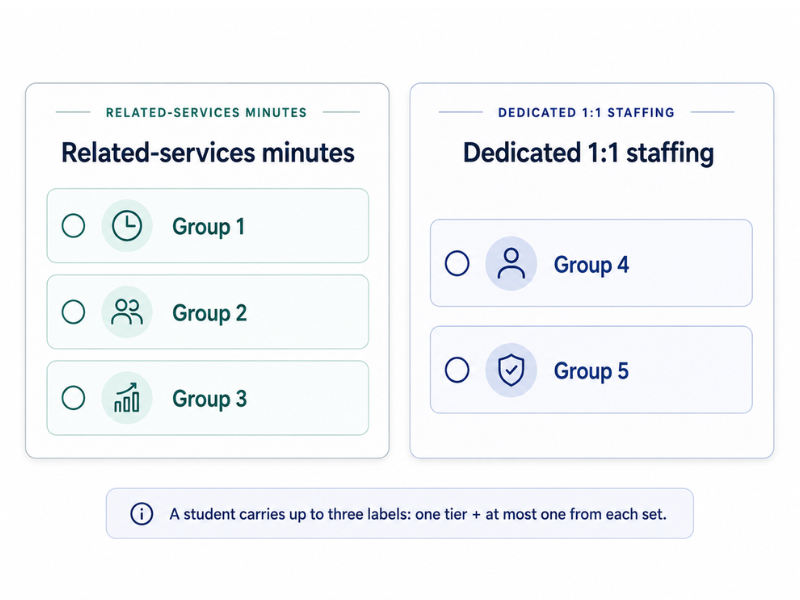
Two grouped boxes — Related-services minutes containing Groups 1–3 on the left, Dedicated 1:1 staffing containing Groups 4–5 on the right, with a note that a student carries up to three labels.

1:1 means dedicated provider time, not setting time. This is a common misread the framework specifically defines against. Groups 4 and 5 measure time during which a provider is exclusively assigned to a single student — a 1:1 paraprofessional, a behavior tech assigned to one student, a nurse providing continuous medical support. A student in a self-contained classroom 80% of the day does not automatically qualify for Group 5 — the time is about dedicated staffing, not about where the student is.

A student can qualify for at most one group from the related-services-minutes set (1, 2, or 3) and at most one from the 1:1-staffing set (4 or 5). Either, both, or neither may apply. So a student carries up to three labels: one tier, plus zero or one of {1, 2, 3}, plus zero or one of {4, 5}.

What's reported when.

Per the TEA TAA letter dated April 16, 2026, the 2026–27 school year is a hybrid year. Districts continue reporting the legacy instructional-arrangement code and the new tier-plus-service-group-plus-minutes-per-day data, for every special-education student, throughout the year.

April 16, 2026

TAA letter published; framework PDF and the TEA funding tool released.

August 14, 2026 (optional)

Districts may submit early student-level tier and service-group data via secure ShareFile to help TEA produce statewide attendance projections for the Legislative Budget Board. TEA is targeting at least 15% of the statewide SPED population. Early-mover signal, not a hard deadline.

First day of 2026–27

Effective date of TEC §48.102 (amended) and §48.1021. Tier and service-group data must be set for every special-education student.

October 8, 2026

First PEIMS submission carrying tier, service group, minutes per day in special education, and eligible days present. (1st Six-Weeks Attendance Submission.) The submission itself is routine PEIMS reporting; what's new is the additional fields.

2026–27 ongoing

When an IEP revision changes services, minutes, or 1:1 staffing, the determination revises with it: prior values end-date, new values begin-date.

September 2027

Settle-up. Final 2026–27 tier weights and service-group dollar amounts are determined by TEA based on PEIMS Summer Submission data. Actual 2026–27 funding is reconciled at this point.

2027–28 school year

Pure service-intensity funding. Instructional arrangement codes are discontinued. The 2026–27 funding floor is gone.

The 2026–27 funding floor under TEC §48.1022(b) means no district receives less than the prior instructional-arrangement formula would have paid that year. A $250M statewide top-up sits above the floor, allocated through the new tier-and-service-group structure. Districts have visibility into their distribution across tiers and service groups today; final dollar weights are set at September 2027 settle-up, so dollar projections aren't yet possible.

What we built.

How Accord supports the funding determinations across the school year.

Populating the determination for every student.

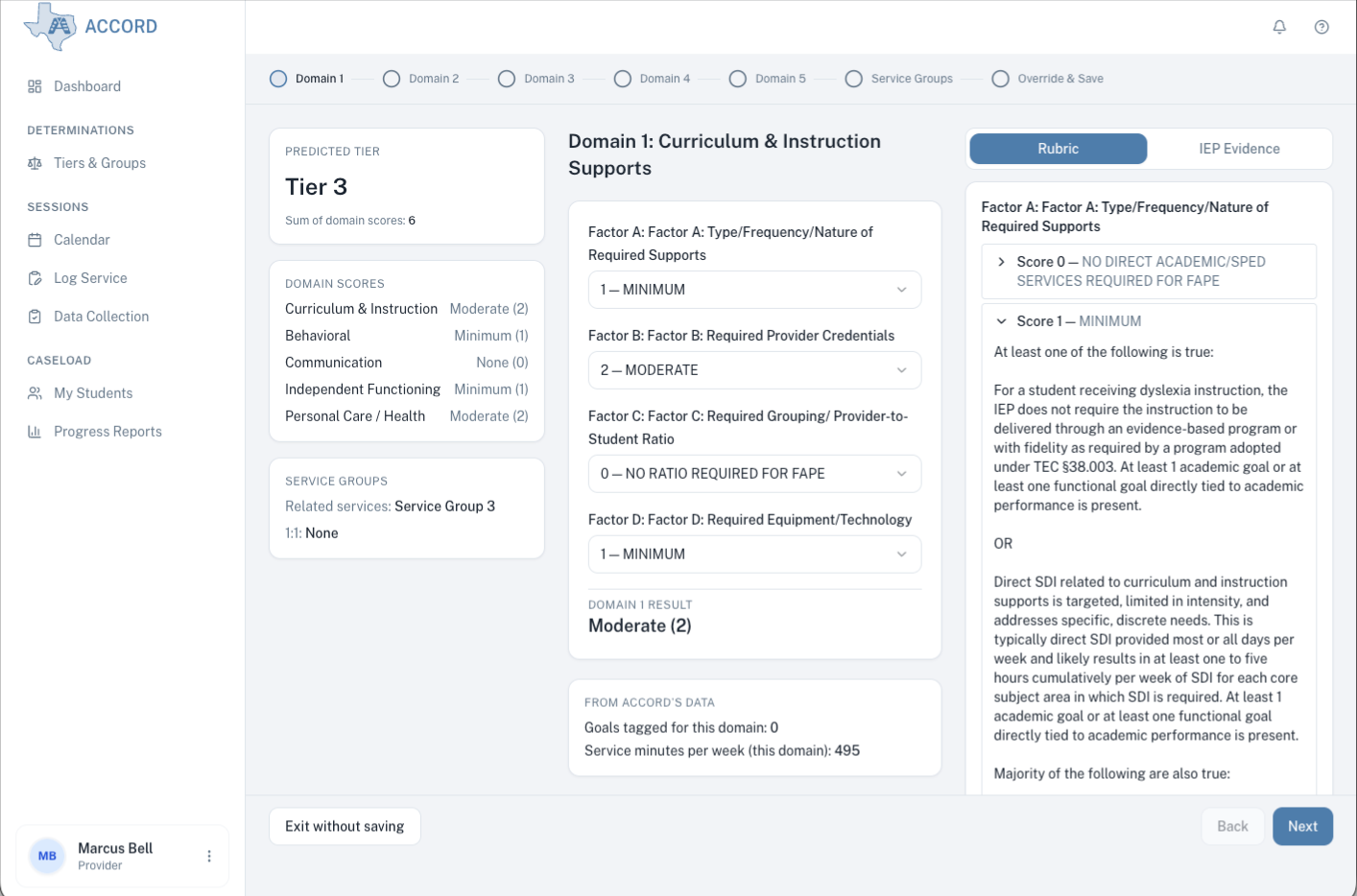
Every special-education student needs a tier and service-group classification before the first day of school, and the data has to be ready for the August 14 voluntary submission and the October 8 PEIMS submission. Accord populates a draft determination at IEP import and routes the case manager through a wizard that surfaces the relevant IEP content and the rubric in the same window — no toggling between pop-ups, no copying between tabs — to produce the tier-and-group classification with the framework's own wording for each rating.

Funding-determination wizard mid-rating — relevant IEP content on one side, rubric language for the current factor on the other.
Determination history for one student — prior values end-dated and new values begin-dated after an ARD revision.

Keeping the determination current as IEPs revise.

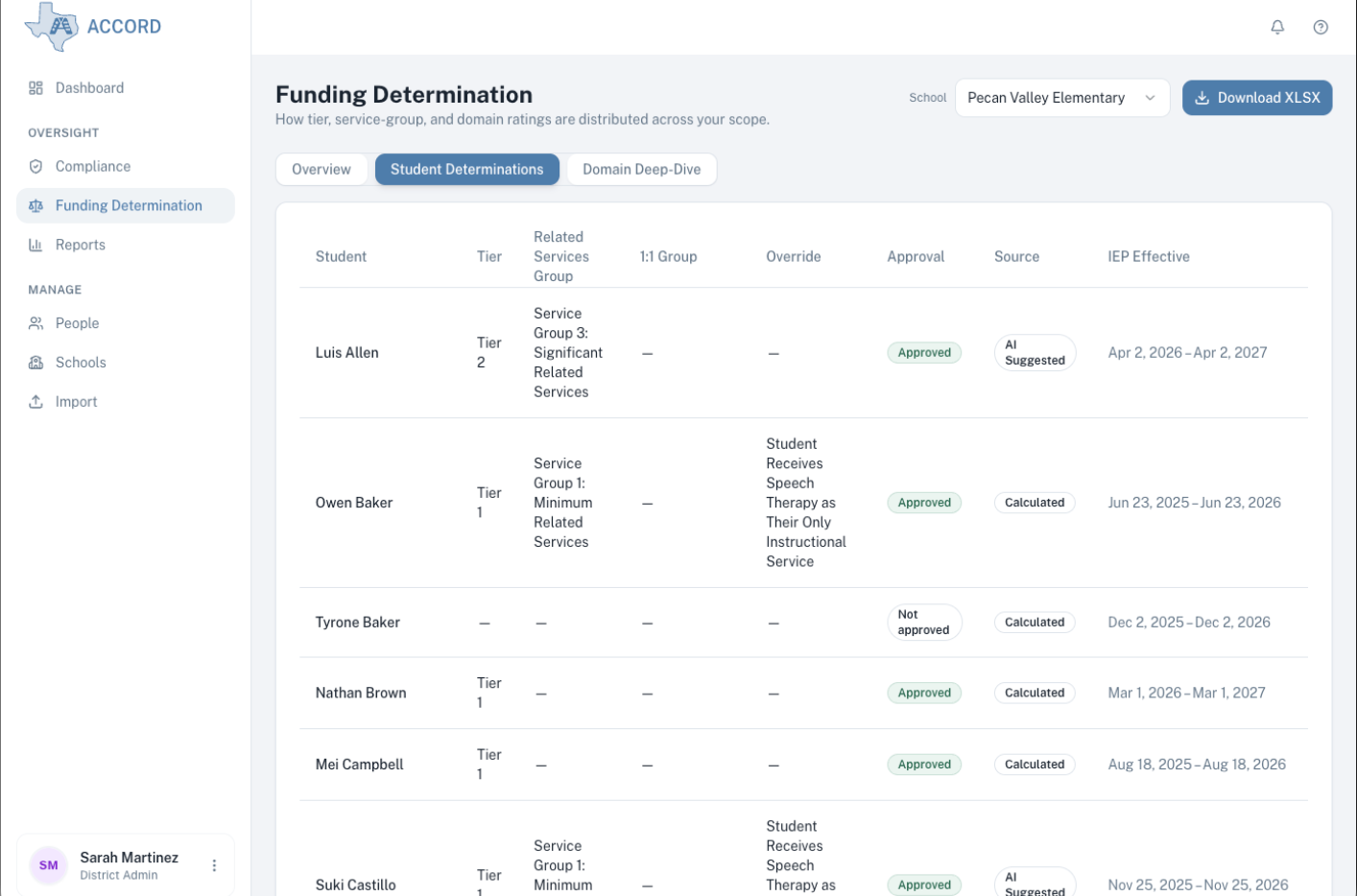
When an ARD revision changes services, minutes, or 1:1 staffing, the determination revises with it. Accord re-runs the wizard and the approval workflow against the revised IEP, end-dating the prior values and begin-dating the new ones. PEIMS picks up the change at the next six-week submission, and the district view across tiers and service groups updates as the underlying IEPs shift.

Talk to us about the funding determination for your district.

Accord is Texas SPED software for the new funding determination and the service-and-goal tracking your team does every day. We work with districts on both. Get in touch.