For Texas SPED directors.
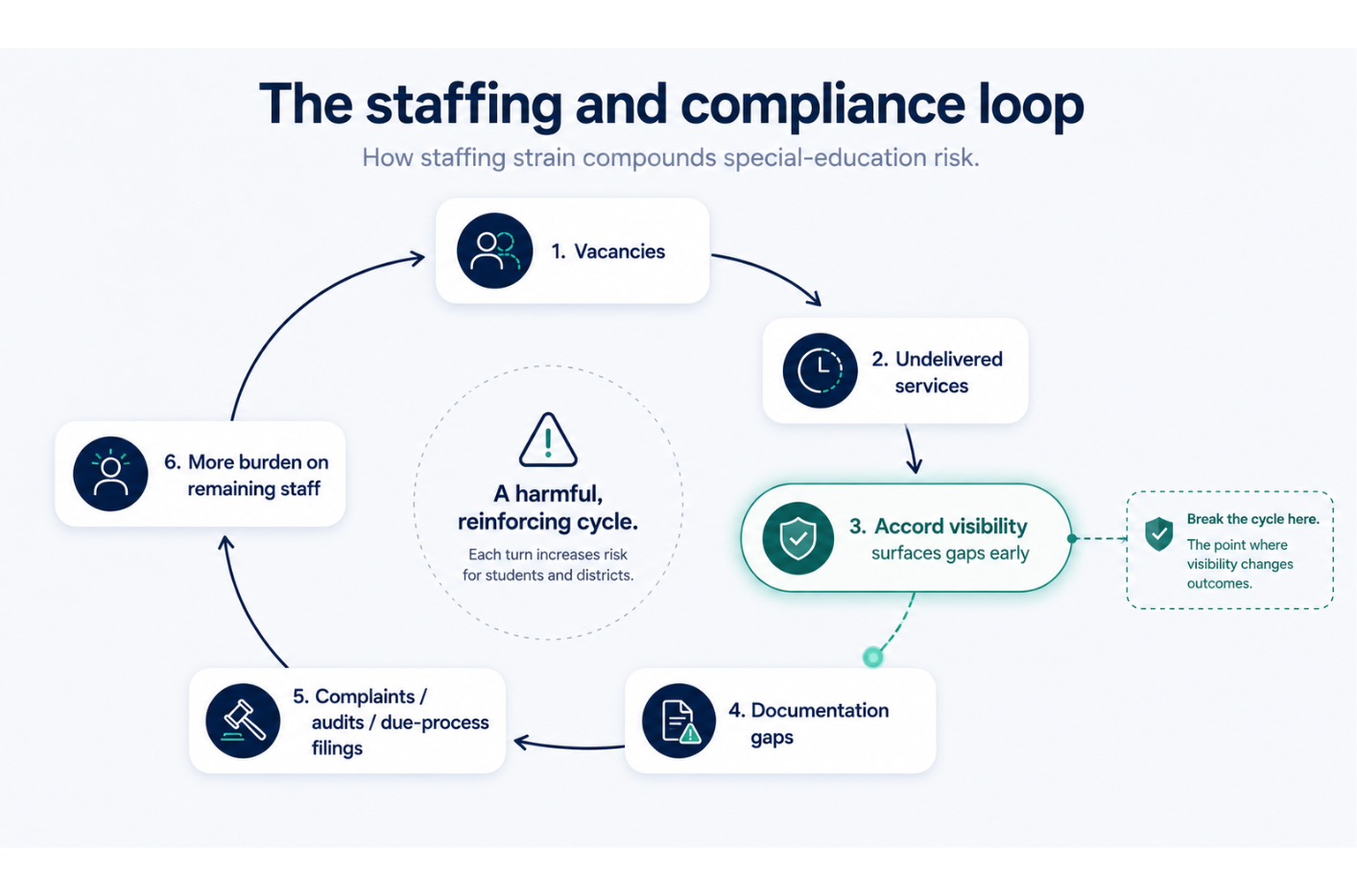
Vacancies a district can't fill turn into services it can't deliver, and the remaining staff don't have the hours to log what they did deliver fast enough to defend it. Every complaint, every audit, every due process filing absorbs more of the staff still in the building. This is the loop Accord is built to break.
The real problem.
Special education teachers in Texas spend an average of five hours a week on compliance paperwork — and in some surveys, up to fifteen.1 Roughly a third of the Texas special education workforce turns over every year, between attrition and transfers out of the field.2 Seventy-four percent of elementary and middle schools couldn't fill their special ed vacancies last year — the hardest-to-fill category in the country.3
5–15 hrs/wk
Texas SPED teachers on compliance paperwork.
SPeNSE Study, U.S. Department of Education.
~1/3
Annual Texas SPED workforce turnover.
Texas Education Agency workforce data; Learning Policy Institute, 2025.
74%
TX elementary and middle schools couldn't fill SPED vacancies last year.
NCES School Pulse Panel, October 2024.
Every vacancy becomes a service the district owed and didn't deliver. Every service delivered without enough time to document it becomes an audit finding, a complaint, or a due process filing — and every one of those burns more of the staff you still have.
“If it's not written down, it didn't happen.”
A SPED director can't make vacancies fill faster than the labor market allows. What a director can do is see, while the school year is happening, which students aren't getting the services their IEP prescribed, and intervene at the campus before the gap turns into a letter from a parent or a finding from TEA. That visibility is what Accord is for.
1. SPeNSE Study, U.S. Department of Education. 2. Texas Education Agency workforce data; Learning Policy Institute, 2025. 3. NCES School Pulse Panel, October 2024.
Service and goal tracking.
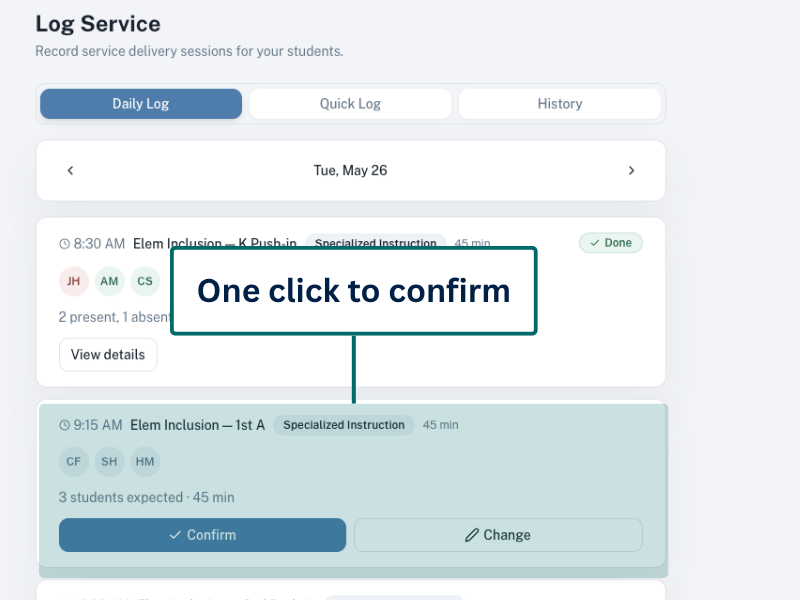
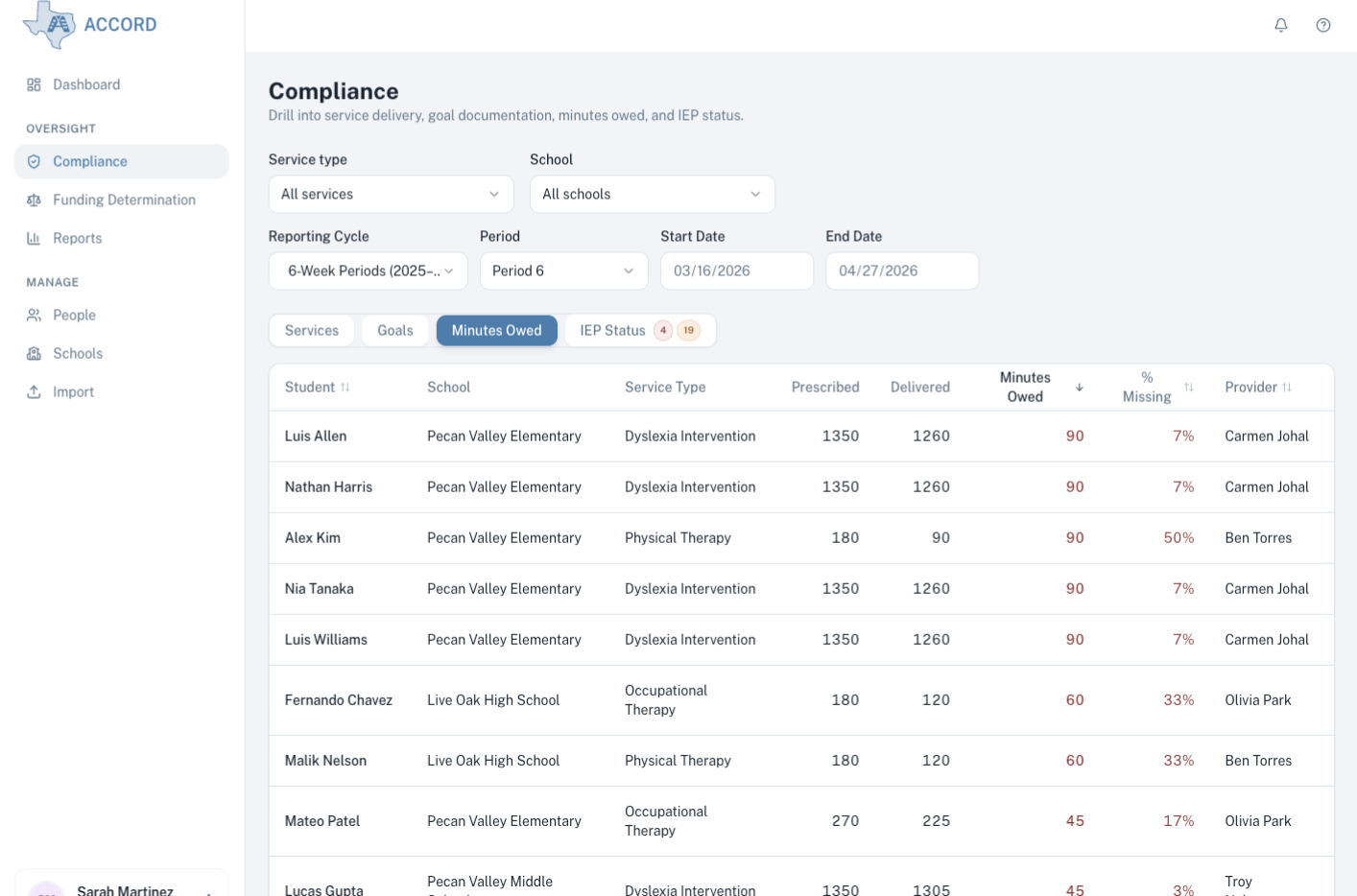
Providers log services as they happen, in the workflow they're already in — schedule open, student selected, session marked delivered. Goal-progress data is captured the same way, for each goal a student is working on — logged by the provider who delivered the session. The director's dashboard shows the prescribed-vs-delivered picture by student, by service type, and by campus, in real time. When a parent, a hearing officer, or TEA asks what was delivered for a student, the answer comes from a record that exists.
Captured the day the work happened.
Sessions and goal data are recorded by the provider who delivered them. The progress reports providers write are easier to produce when the goal data has been accumulating all along.
The gap visible early, not at year-end.
The dashboard surfaces where service delivery is drifting from what each student's IEP prescribed, while there's still time to address it with the campus.
Funding determination.
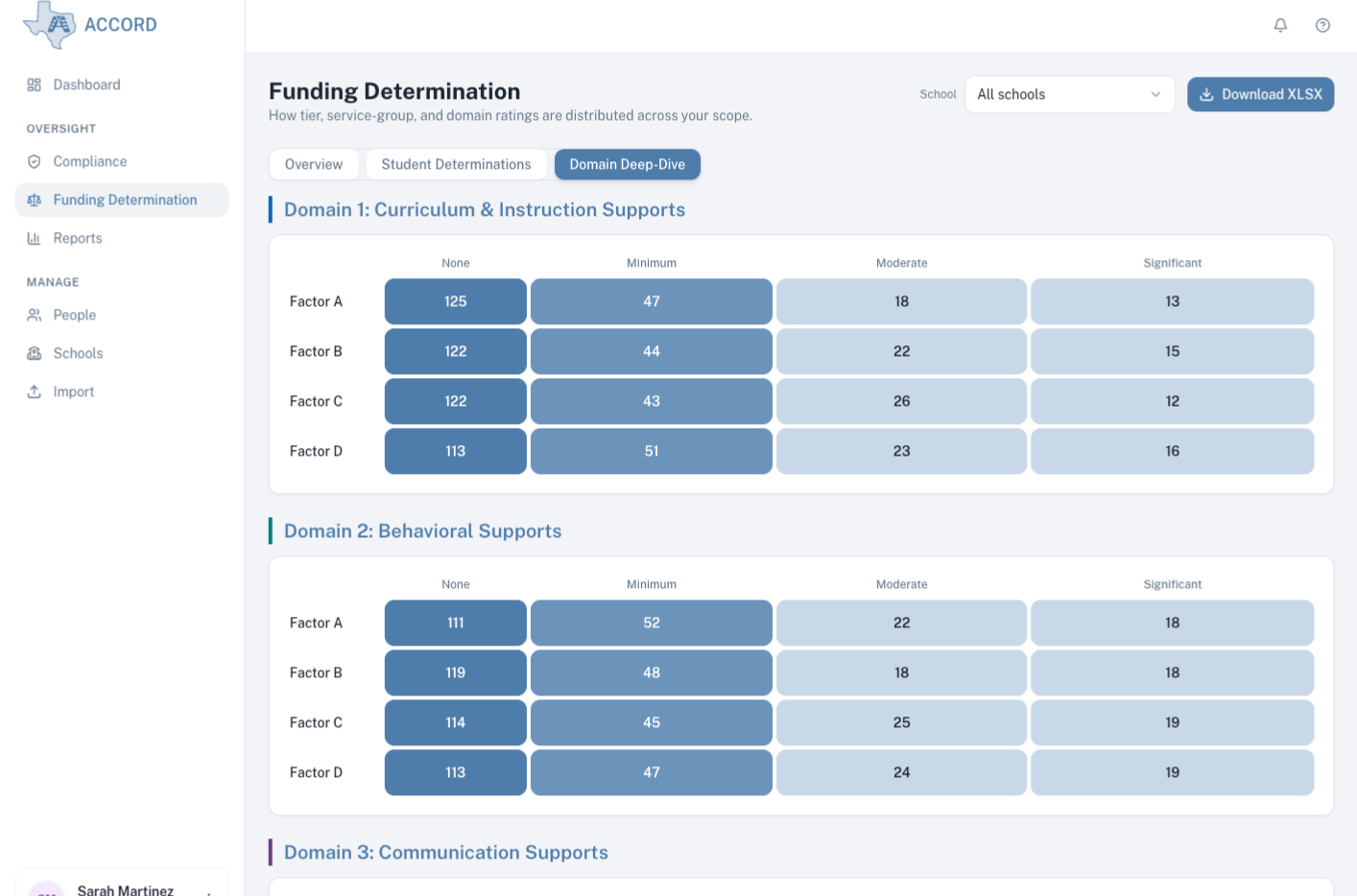
Texas SPED directors are also responsible this year for classifying every student in the new intensity-of-services funding model — every student into a tier and the service-group qualifications before the first day of the 2026–27 school year, with the August 14 voluntary submission and the October 8 PEIMS submission both ahead of summer. Accord ships a case-manager wizard that surfaces the rubric and the IEP in the same window, with a district view across all eight tiers and the two service groups and a consolidated dataset one click away.
You'll see the gap dashboard your director's view starts from, the wizard your case managers will use for the new funding model, and the parent view your district can give every parent in the department.